Where is G B Road

G.B. Road Stants for Garstin Bastion Road or some history writers says “Gates and Bastions Road” is an area from Ajmeri Gate to Lahori Gate, in Old Delhi India. So, in this way the gb road full name is either Garstin Bastion Road or Gates and Bastions Road. This is a world famous red-light area having hundreds of multi-story brothels having more than 1000 female sex workers. In the year 1966 government officially renamed this road by Swami Shradhanand Marg.

Quick Facts about G B Road Delhi

Name G.B. Road
City Old Delhi
State Delhi
Coordinates 28°38′51″N 77°13′22″E
Country India
Establised Mughal Era
Clubbed and Rename 1863
Renamed Swami Shradhanand Marg in 1966
Full form of G B Road Garstin Bastion Road or “Gates and Bastions Road
PIN Code 110006

GB Road Delhi Map

G B Road Delhi Map at Google

G B Road Full form in Hindi

G B Road का हिंदी में अर्थ है गार्स्टिन बैस्टियन रोड जबकि कुछ इतिहास लेखकों का कहना है की G B Road का मतलब “गेट्स और बैशन रोड”.

Monuments near GB Road Delhi

GB Road now officially Swami Shradhanand Marg is inbetween Ajmeri gate to lahauri gate so a few historical monuemnts of Delhi are near by this location like India Gate is around 6 KM and Red Fort of Delhi is around 3 KM and

Where is Karachi

Karachi is located in the Sindh Region of Pakistan at the elevation of 8 meter from sea level with coordinates or lat long 24°51′36″N 67°0′36″E, nearest airport i.e Jinnah International Airport Karachi (IATA code: KHI) east of the city center in a distance is 19.2 k/m.

Where is Karachi located in Pakistan

Know where is Karachi located in Pakistan on Google Map


Information about where is karachi situated

Name Karachi
Country Pakistan
Continent Asia
Came in existence 1742 (As per Dutch document)
Previous name any Kolachi(Till 1742)
Area in KM 3,527 km2
Area in miles 1,362 sq mi
Population 24,300,000 (Est 2016)
Population Density 42.5 people per km2 (2016)
Lat Long 24°51′36″N 67°0′36″E
Name of Monuments Ziarat Residency, Pakistan Monument, House of Abdus Salam, Allama Iqbal’s Tomb, Allama Iqbal Museum, Islamic Summit Minar, Minar-e-Pakistan, Khaliq Dina Public Hall, Quaid-e-Azam’s Mazar, Quaid-e-Azam House Museum, Birthplace of Muhammad Ali Jinnah
Places to Visit Dolmen Mall Clifton, Mazar-E-Quaid, Mohatta Palace Museum, Frere Hall, Boat Basin, Zainab Market, Hilal Park, Ocean Tower, Park Towers, Bin Qasim Park Clifton, Quaid-e-Azam House Museum, Tooba Mosque, Bin Qasim Park, Safari Park
Time Zone GMT+5.
STD Code +(92)21
Zip Code Start 74200 (GPO)
Languages Urdu, Sindhi, Punjabi, Pushto, English
Mayor Sajjad Hussain Abbasi
Transportation Taxis, car, city bus, Airport
Rivers Malir River and Lyari River
Lakes Hub Lake and Haleji Lake
Airports Jinnah International Airport

Know Where is Saragarhi

Path Map of Cyclone Asani

During the early hours of Sunday, May 8, the potent system based in the Bay of Bengal intensified into a Cyclonic Storm, effectively transforming into Cyclone Asani. From here on, it is expected to gather more strength and evolve further in the next 24 hours.
Current Wind Speed 50 knots / 58 MPH

Max Predicted Wind Speed 50 knots / 58 MPH at May 11, 2022 5:30am


A rapid intensification
The transformation of this system into a cyclone occurred much earlier than previously expected. Initial predictions had indicated that the deep depression would not strengthen into a Cyclonic Storm until the evening hours of Sunday.

However, as per the India Meteorological Department’s (IMD) latest update, the cyclone had already formed sometime around 2:30 am on Sunday.


Source-https://www.cyclocane.com/asani-storm-tracker/

Furthermore, as of 5:30 am, it was located over southeast Bay of Bengal — about 450 km west-northwest of Car Nicobar (Nicobar Islands), 380 km west of Port Blair (Andaman Islands), 970 km southeast of Visakhapatnam (Andhra Pradesh) and 1030 km south-southeast of Puri (Odisha).

Cyclone ASANI storm path from JTWC

Time Speed Location Status
May 9, 2022 5:30am 55 knots 14.0, 86.1  
May 9, 2022 5:30pm 50 knots 14.8, 85.1  
May 10, 2022 5:30am 45 knots 15.5, 84.5  
May 10, 2022 5:30pm 45 knots 16.3, 84.1  
May 11, 2022 5:30am 40 knots 17.0, 84.0  
May 12, 2022 5:30am 40 knots 18.1, 84.7  
May 13, 2022 5:30am 35 knots 20.1, 87.4 dissipating
May 14, 2022 5:30am 30 knots 22.8, 90.9 dissipated

From here on, the system will continue to move northwestwards, and gradually intensify into a Severe Cyclonic Storm over east-central Bay of Bengal by the early hours of Monday, May 9. This is when the system is expected to be at its strongest, as it may pack wind speeds up to 60 knots (111 km per hour).

Thereafter, its northwestward movement will continue, and by Tuesday evening, Severe Cyclone Asani will reach west-central and adjoining northwest Bay of Bengal — off the coasts of North Andhra Pradesh and Odisha. It is then likely to recurve north-northeastwards and move towards northwest Bay of Bengal, off the Odisha coast.

Landfall unlikely over Odisha, Andhra Pradesh
According to IMD Director-General Mrutyunjay Mohapatra, the aforementioned recurving of the system in the northeastern direction may end up sparing the states of Odisha and Andhra Pradesh from the possibility of a cyclone landfall.

In fact, he has opined that this movement may result in Cyclone Asani moving parallel to India’s eastern coast.

The Weather Channel’s met team has added that while this parallel movement continues, the system may start losing steam by Wednesday night or Thursday morning, and begin its gradual deintensification process.

Expected impact over East India
As for its impact on East India, the IMD has predicted isolated heavy rains over coastal Odisha and north coastal Andhra Pradesh from Tuesday evening onwards, while similar conditions will engulf coastal West Bengal starting Wednesday.

The sea conditions will remain rough throughout, and therefore, the fisherfolk have been advised not to venture into the waters, especially in central Bay of Bengal from May 9-10 and northwest Bay of Bengal from May 10-12.
Source- https://weather.com/en-IN/india/news/news/2022-05-08-cyclone-asani-to-intensify-into-severe-cyclonic-storm-on-may-9

Path map of in fa fabian

The Philippines was hit by typhoon In-Fa and expected to make landfall in the eastern or northeastern coastal areas of China. Typhoon In-fa, known in the Philippines as Typhoon Fabian, is an active tropical cyclone in the East China Sea, threatening China.

Keypoints

The storm has exacerbated and played a part in starting the 2021 Henan floods. Since 17 July 2021, China’s Henan province has been affected by severe flooding, caused by a period of prolonged heavy rainfall.
According to projections, In-fa would beat Typhoon Fitow of 2013 as the costliest typhoon to strike China, and the third costliest typhoon on record (a total of $14.7 billion) when adjusted for inflation.
What is Cyclone?
Cyclone is a storm where the low-pressure zone is surrounded by a high-pressure zone. Air moves inward from high to low-pressure zone and under the influence of Coriolis force whirls anticlockwise in Northern Hemisphere and clockwise in Southern Hemisphere.

* High-Pressure Zone: High-Pressure Zone is a region where the atmospheric pressure at the surface of the planet is higher than its surrounding environment.

* Low-Pressure Zone: Low-Pressure Zone is an area where the air pressure is lower than that of surrounding areas.

How a Cyclone is formed?
The formation of cyclones usually takes place in the low-pressure areas. These are formed over masses of warm water (like ocean, sea, etc.) near the equator. The rising of warm moist air begins the cyclonic process. When the warm air starts rising, the cooler air rushes in to fill the void left by the warm air. The warm, moist air cools as it rises higher into the air and forms clouds. As the process continues it begins to pick up speed and eye forms in the center. The eye is the lowest pressure spot in the storm (cyclone). This process is officially known as cyclone when wind speeds reach 74 mph.

When the cyclone hits the land, this process begins to slow due to the absence of warm air. However, this takes an extraordinary amount of time to dissipate completely.

Types of Cyclone
Characteristic Tropical Cyclone Polar Cyclone Mesocyclone
Nature
Tropical cyclones are closed air circulation around a low-pressure center.
This wind movement is caused by atmospheric disturbances coupled with the earth’s ‘rotation.
Polar cyclones are also known as Arctic Cyclones.
These are large areas of low pressure and are usually 1,000 to 2,000 kilometers wide in which the air is moving in a spiral counterclockwise fashion in the northern hemisphere.
A mesocyclone is a vortex (spiral) of air within a convective storm (approximately 2 to 10 miles in diameter).
It is the air that rises and rotates around a vertical axis, normally in the same direction as low-pressure systems in a given region.
Region of Occurrence
It happens over tropical ocean regions and of two types- Hurricanes and typhoons.
Hurricanes are found in the Atlantic and Northeast Pacific region, whereas Typhoons are found in the Northwest Pacific region.
It usually occurs over Polar Regions of Siberia, Greenland, and Antarctica.
It is strong during the winter season.
These types of cyclones are followed by the rotating air inside the thunderstorm.
Mostly occur in the North American region.
Tropical Cyclones and their Regional Names
Tropical Cyclones have a diameter of 100 to 500 kilometers. These are known by different names in different regions such as:

Characteristics Hurricanes Typhoons Cyclones Tornadoes
Region of Occurrence
These are tropical storms in the West Indies and the Gulf of Mexico which usually occur in August-September.
These may bring thunderstorms and torrential rain.
These are tropical storms in the China Sea along with China and Japan coast.
These are similar to Hurricanes of the USA which may bring thunderstorm and torrential rain.
These are tropical low-pressure system occurring at the Indian coast in Bay of Bengal and the Arabian Sea.
These also bring thunderstorm and rain.
These are also known as Twisters (mainly in the USA). These are very intense and occur in Mississippi Missouri basin in the USA.
These are accompanied by dark funnel-shaped clouds.
Velocity of Wind
Wind blows with 160 to 180 kmph
The wind blows with speed to 160 to 180 kmph.
These whirl with a wind speed of 280 to 300 mph.
Winds are very violent with a speed of 350 to 500 mph.
Willy-Willy: These are the tropical storm which originates in the coast of North-West Australia

*Anticyclones: These are high-pressure belt surrounded by the low-pressure belt. The wind blows outward in the clockwise direction in Southern Hemisphere.

Significance of Cyclones
The Cyclones levels down the inequalities of pressure and wind movement over the globe.
They play an important role in the complex process of heat exchange between various latitudinal zones.
Cyclones have an effect over the phenomenon of precipitation, more so in the mid-latitude regions, by lifting up the moist air from oceans and carrying it into the surrounding landmasses.

Where is Belur Karnataka

Belur was the early capital of the Hoysala Empire. Belur along with Halebidu about 16 km away is one of the major tourist destinations in Karnataka. According to inscriptions discovered here, it was also referred to as Velur or Velapuri. It was the early capital of the Hoysala kings in 11th-century and remained a second capital through the 14th-century. The city was so esteemed by the Hoysalas that it is referred to as “earthly Vaikuntha” (Vishnu’s abode) and “Dakshina Varanasi” (southern holy city of Hindus) in later inscriptions.

The mineral beryl and the element beryllium might have gotten their names from this city, world famous Chennakeshava Temple is Located here.

Fact about Belur

City Belur
District Hassan
State Karnataka
Country India
Continent Asia
Area NA
Population 28,754
Population Density NA
Lat Long 13.1629°N 75.8571°E
Time Zone IST (UTC+5:30)
STD (0)8177
Zip Code Start 573115
Languages Kannada
Rivers NA
Airports Nearest airport is 200 kilometres (124 mi), Bengaluru (IATA Code: BLR)
Vehicle registration KA-13/ KA-46
Sex ratio NA
Literacy NA
Nick Name Dakshina Varanasi

Where is Belur Located

Where is Ayodhya Uttar Pradesh

Ayodhya is one of the city of The Ayodhya District before the creation of Ayodhya as District this city comes in faizabad District, from the various major cities of Uttar Pradesh, Ayodhya is located Ayodhya District, of Uttar Pradesh, an state of India, the Lat. Long. of Ayodhya is 26.80°N 82.20°E. , and the height of this Town from sea level is 93 m (305 ft), the nearest Airport is faizabad (Where is Faizabad) airport, Ayodhya connected with other Indian cities by 1 major National Highways ( NH-135A) and other State Highways with Lucknow (134 km), Gorakhpur (132 km), Jhansi (441 km), Allahabad (166 km) (Where is Prayagraj), Sravasti (109 km), Varanasi (209 km) and Gonda (51 km).

Where is Ayodhya Located

Aydhya Location on Google Map

Facts about about Ayodhya City

Name Ayodhya
District Ayodhya
State Uttar Pradesh
Country India
Continent Asia
Area 79.8 km2 (30.8 sq mi)
Population 55,890
Population Density 700/km2 (1,800/sq mi)
Lat Long 26.80°N 82.20°E
Time Zone IST (UTC+5:30)
STD (0)5278
Zip Code Start 224001
Languages Hindi
Rivers Saryu
Airports Nearest airports are Faizabad 5 km away, Amausi in Lucknow 134 km away, Allahabad 166 km away
Vehicle registration UP-42
Sex ratio 997
Literacy 78.10%

Places to Visit in Ayodhya

  • Prayagraj
  • Kanak Bhavan Temple
  • Brahma Kund
  • Ram ki Paidi
  • Ayodhya Ghaat
  • Hanuman Garhi temple
  • Vijayraghav Mandir
  • Sant Sri Paltds Temple
  • Ram Janmabhoomi
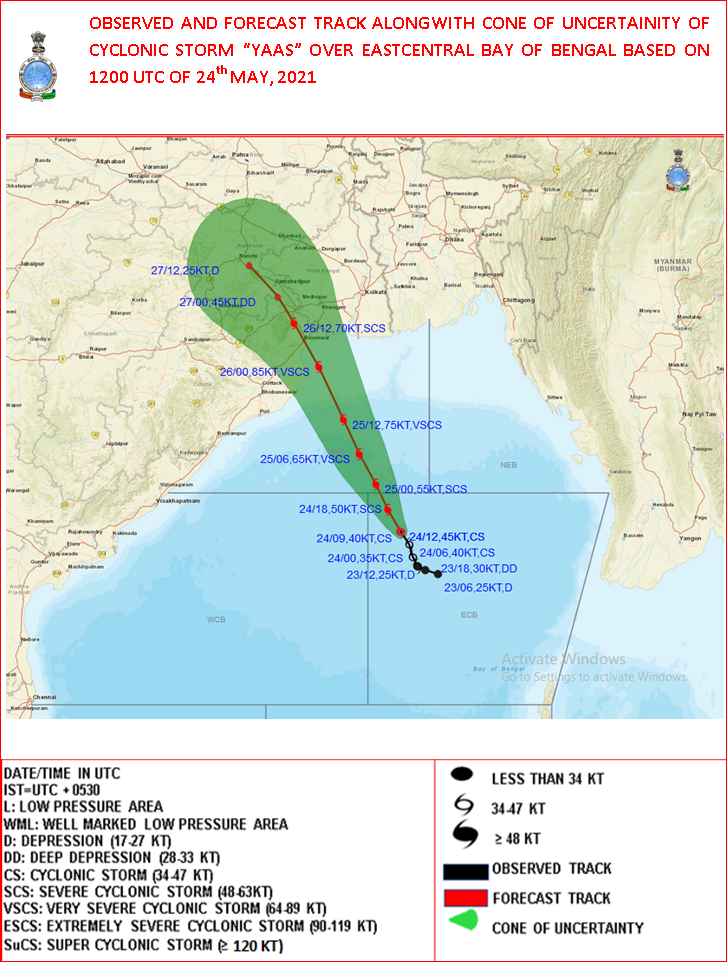
  • Yaas cyclone path map

    “Light to moderate rainfall expected at most places with heavy to very heavy rains at few places with extremely heavy falls at isolated places in Bhadrak, Jagatsinghpur, Cuttack, Balasore, Dhenkanal, Jajpur, Mayurbhanj, Kendrapara, and Keonjhargarh today,” the IMD said.

    Cyclone Yaas is ‘very likely’ to cross north Odisha– West Bengal coasts between Paradip and Sagar Island around Balasore, during noon of May 26 as a Very Severe Cyclonic Storm, the weather department said.

    The IMD on Monday tweeted the course of Cyclone Yaas and said, “Depression over Eastcentral Bay of Bengal intensified into a Deep Depression and about 600 km north-northwest of Port Blair. To intensify into a Cyclonic Storm by 24th May morning and further into a Very Severe Cyclonic Storm during the subsequent 24 hours.”


    Cyclone Yaas is expected to be formed in the Bay of Bengal on may 22. Warning that sea conditions are likely to be rough to very rough, the Met Department advised fishermen not to venture into the Bay of Bengal from May 24.
    After severe cyclonic storm Tauktae in the west coast, another cyclone named Yaas is likely to hit the east coast on May 26, the India Meteorological Department (IMD) said on Wednesday.

    The name Yas for an upcoming cyclone in future of 2020 has been proposed by Oman officially know Sultanate of Oman, is a country on the southeastern coast of Arabian Peninsula in Western Asia, in the world there are only 13 countries can proposed the name of hurricane and cyclone, in these five are gulf countries and name of these five countries are Iran, Qatar, Saudi Arabia, the United Arab Emirates and Yemen and the name of other eight countries are India, Bangladesh, Myanmar, Pakistan, Maldives, Oman, Sri Lanka and Thailand.
    After the Amphan cyclone we get very fine interest about the cyclones, and after this another cyclone about to come its name is Nisargo Cyclone and it is suggested by Bangladesh.
    As of now we have no any information about the path map of Yas Cyclone and no any information about its date, but it will also be originated after the Yas Cyclone that is suggested by Myanmar.

    Name of Expected Cyclones in 2020

    Cyclone Amphan path map

    Super cyclone Amphan (alluding to the Thai word for “sky”) developed in the Bay of Bengal as the strongest cyclone ever to be recorded in the region, comparable to a Category 5 hurricane.

    Cyclone Yaas Path Map

    During May 13, an area of low pressure developed over the southeastern Bay of Bengal about 1020 km (635 mi) to the southeast of Visakhapatnam (Know Where is Visakhapatnam) in the Indian state of Andhra Pradesh (See the Cities of Andhra Pradesh).

    Quick Updates on Amphan Super Cyclone

    • Super Cyclone Amphan was named 18 years ago.
    • Thailand named the storm in 2004.
    • That was the first stage of naming the storm.
    • Cyclone Amphan has claimed 86 lives in West Bengal and caused havoc in at least 14 districts.
    • Over 44.45 Lakh People Affected Due To Cyclone Amphan In Odisha
    • 9833 number of villages, 1558 Gram Panchayats in 92 Blocks and 272 Wards in 22 Urban Local Bodies have been affected in 10 districts of Odisha.
    • Over 5,000 trees uprooted, hundreds of lamp posts damaged
    • Power supply, phone connectivity disrupted in Kolkata
    • NDRF teams continue with restoration work in Bengal’s Uluberia
    • Odisha assesses damage, thanks IMD for heads-up
    • Two NDRF teams from Pune airlifted for relief work in cyclone-hit Bengal
    • Kolkata Airport flooded, 5,000 trees uprooted; no power, phone, Internet connections
    • State of Kerala stands in solidarity with the people of Odisha

    Amphan Cyclone Current Position


    Source: https://mausam.imd.gov.in/

    Major Cyclones in India

    S. No Name Date Affected States Speed
    1 Cyclone Vayu 10 June 2019 – 19 June 2019 India, Pakistan, Maldives, Oman, Lakshadweep 185 km/h
    2 Cyclone Fani 26 April 2019 – 5 May 2019 Odisha, Bangladesh, Sri Lanka, Andhra Pradesh, East India 250 km/
    3 Cyclonic Titli October 8 – October 12, 2018 Andhra Pradesh, Odisha 150 km/h
    4 Cyclone Hudhud 8 October 2014 – 14 October 2014 Visakhapatnam, Odisha, Andhra Pradesh 215 km/h

    Cyclone Amphan Updates

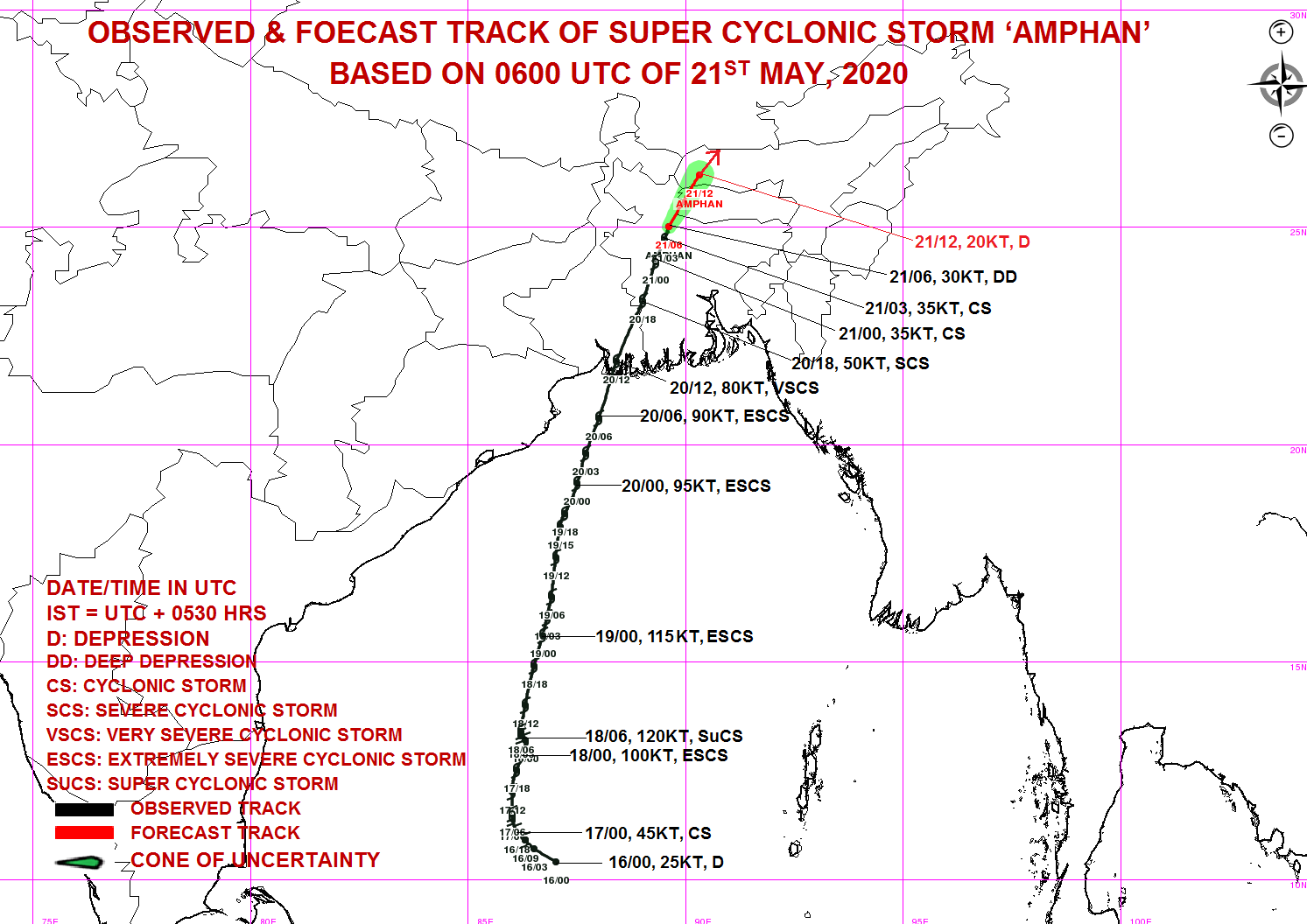
    [21st May 2020 11.55AM]Cyclone Amphan made landfall in eastern India and Bangladesh on Wednesday, killing at least 15 people as it lashed coastal areas with ferocious wind and rain.

    [21st May 2020 09.15AM]West bengal- Water logged in streets, vehicles crushed under fallen trees and broken river jetties were also all over local media

    [21st May 2020 08.05AM]A total of 12,078 cyclone shelters were prepared throughout the country’s coastal regions, where over 2 million people were evacuated.

    Cyclone Amphan Path Map of 21st May 2020
    Source:BBC
    [20th May 2020 03.15PM] NDRM teams are working, high alerts for the 8 states of India, outer part of Storm hits the west Bengal and Odisha.

    [20th May 2020 03.05PM] Storm from Bay of Bengal will hit the West Bengal at Digha with the speed of 100-110 KM/hr.

    [20th May 2020 03.00PM] Due to Amphan Cyclone air is blowing 100KM/Hr and water waves are very high in Sea means Bay of Bengal.

    [20th May 2020 01.40PM] Amphan Cyclone will hit the coastal of West Bengal by 2.30 PM today.

    [20th May 2020 11.00AM] On Wednesday and Thursday, extremely heavy rain falls are forecast across coastal West Bengal in districts like East Medinipur and West Medinipur, South 24 Parganas and North 24 Parganas, Howrah, Hoogli and Kolkata.

    [20th May 2020 11.05AM]High alert districts of Odisha are Gajapati, Ganjam, Puri, Jagatsinghpur, Kendrapara, Jajpur, Balasore, Bhadrak, and Myurbhanj

    [20th May 2020: 7.20AM]Amphan Cyclone, now in the category of Extremely Severe Cyclone, has moved closer to the mainland and is few hours away from making landfall today. As of 2:30am on Wednesday, it lay at 180 kms south of Paradip, Odhisha and south-southwest of Digha, West Bengal.
    [19th May 2020: 10.12PM] The Cyclone will hit the coastal area of India by Wednesday i.e 20th of May 2020.

    [18th May 2020: 11.30PM] The cyclone is moving closer to the two states. “The Super Cyclonic AMPHAN at 2330 hrs IST of 18th May, 2020 near latitude 14.9°N and longitude 86.5°E over Westcentral Bay of Bengal about 600 km nearly south of Paradip (Know the Cities of Odisha), o750 km south-southwest of Digha (See the Cities of West Bengal).
    Source:https://twitter.com/Indiametdept

    Predicted Path map of Cyclone Amphan

    Predicted Path map of Cyclone Amphan

    Quick Facts about Cyclone Amphan

    Name Amphan
    Status Super Cyclonic Storm
    Origin Bay of Bengal
    Position 15.6° N, 86.8° E
    Affected states Odisha and West Bengal
    Winds 222 km/h
    Date of Origin 13th May 2020
    Wind Gusts 268 km/h
    Predicted hit to India 20th May 2020
    Movement NNE 17 km/h

    Super Cyclonic Storm Amphan (JTWC designation: 01B) is currently a very powerful tropical cyclone over the Bay of Bengal threatening Odisha and West Bengal in India as well as Bangladesh.

    How Amphan Cyclone Affect the Indian States

    It is the first tropical cyclone of the 2020 North Indian Ocean cyclone season. Amphan is the first super cyclonic storm in the Bay of Bengal since the 1999 Odisha cyclone, as well as the most intense cyclone ever recorded in the North Indian Ocean in terms of minimum central pressure and 3-minute sustained winds.

    Cyclone Amphan route map

    Cyclone Amphan path map

    The storm is expected to make landfall in between Digha (West Bengal, India) and Hatia Islands (Bangladesh) on Wednesday, 20 May 2020. However, it is expected to weaken and turn into a Extremely Severe Cyclonic Storm before hitting the coast. (Source: wikipedia)

    Cyclone Tauktae Path Map

    Cyclones Tauktae from the Indian Ocean are more likely to occur in the Bay of Bengal, especially in April or late April 2021. It mainly affects the coastal areas of Myanmar, Bangladesh and India.

    Cyclone Tauktae Updates

    12:49 (IST) May 16
    Considering the prevalent weather conditions in, around, and enroute to Goa due to the very severe cyclone Tauktae, all airlines have cancelled their flight operations to and from Goa for today.
    Goa airport director Gagan Malik
    12:45 (IST) May 16
    Cyclone Tauktae has intensified into a “very severe cyclonic storm” and is approaching the Gujarat coast: India Meteorological Department (IMD)

    12:40 (IST) May 16

    Goa’s Panaji witness the spell of Cyclone Tauktae
    12:36 (IST) May 16
    Union HM Amit Shah chaired a review meeting with the chief ministers of Gujarat, Maharashtra and Administrator of Daman and Diu and Dadra Nagar Haveli to assess the preparedness of states and central ministries to deal with the situation arising out of Cyclone Tauktae. (ANI)

    12:19 (IST) May 16
    Kerala is also likely to experience light to moderate rainfall at many places with heavy to very heavy falls at isolated places on May 16 and heavy falls at isolated places on May 17: IMD

    11:59 (IST) May 16
    Districts near the Konkan coast have been asked to prepare for the cyclone. The chief minister has taken stock of the matter. I’ve informed him about the rehabilitation work. We have given instructions for the preparation of large shelters in these areas.

    Maharashtra relief and rehabilitation minister Vijay Wadettiwar
    11:46 (IST) May 16
    The water level in the sea has increased and it is expected to rise further by afternoon. All the fishermen are on alert to ensure their canoes are not pulled into the waters by strong currents: Local fisherman

    11:39 (IST) May 16
    Hundreds of electric poles are broken and scores of power conductors have snapped. Many high tension 33 KV feeders are down due to the falling of trees. Even the 220 KV lines bringing power to Goa from neighbouring Maharashtra have been damaged.

    Goa power minister Nilesh Cabral

    11:37 (IST) May 16
    Cyclone Tauktae: Strong winds, rain in Goa; power supply hit

    Gusty winds and heavy rains lashed several parts of Goa on Sunday morning due to cyclonic storm Tauktae, uprooting electric poles and affecting power supply in many parts of the coastal state, officials said. (PTI)

    11:31 (IST) May 16
    Cyclone Tauktae: 24 NDRF teams deployed in Gujarat

    Our teams are prepared with all the necessary equipment and will be on standby. Wherever it is required, teams will be deployed. As many as 24 teams will take their place by 5 pm, with 13 teams from outside. Eight teams were called from Punjab and five from Odisha: NDRF deputy commandant Ranvijay Kumar Singh

    11:14 (IST) May 16
    I am in contact with district in-charge ministers and DCs of the affected districts to ensure rescue and relief operations.

    Karnataka CM BS Yediyurappa
    11:13 (IST) May 16
    We are closely monitoring the cyclone situation in coastal areas, says Karnataka CM BS Yediyurappa.

    11:00 (IST) May 16
    Cyclone Tauktae is very likely to keep moving in north northwest direction. By late afternoon, its centre will be north-northwest of Goa. Gale winds and rainfall will continue for almost the entire day: India Meteorological Department (IMD)

    10:53 (IST) May 16
    Gujarat chief minister Vijay Rupani instructs state ministers to reach Bharuch with immediate effect to review the preparedness of the government to tackle possible cyclone situation. (ANI)

    10:42 (IST) May 16
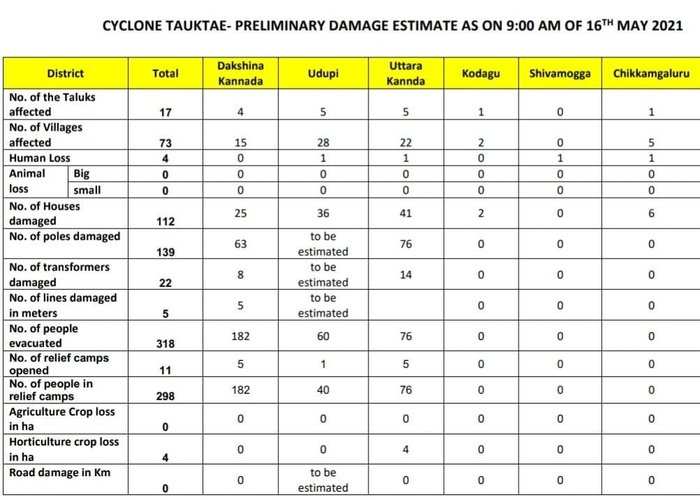
    Due to cyclone Tauktae, heavy to extremely heavy rainfall was observed over 6 districts, 3 coastal districts and 3 Malnad districts in the past 24 hours. So far, 4 people have lost their lives, 73 villages affected: Karnataka State Disaster Management Authority (KSDMA)

    Due to cyclone Tauktae, heavy to extremely heavy rainfall was observed over 6 districts, 3 coastal districts and 3 Malnad districts in the past 24 hours. So far, 4 people have lost their lives, 73 villages affected: Karnataka State Disaster Management Authority (KSDMA)
    10:24 (IST) May 16
    Districts near the Konkan coast have been warned for cyclone. The CM has taken stock of the matter. I’ve informed him about the rehabilitation work. We have given instructions to prepare large shelters in these areas.

    Maharashtra relief & rehabilitation minister Vijay Wadettiwar

    10:17 (IST) May 16
    Maharashtra chief minister Uddhav Thackeray to brief Union home minister Amit Shah about state preparedness for cyclone Tauktae developing in Arabian Sea.

    10:12 (IST) May 16

    Cyclone Tauktae hits coastal parts of Goa.

    10:07 (IST) May 16

    NDRF teams deployed in Gujarat
    10:06 (IST) May 16
    NDRF teams have been deployed in the state in view of the cyclonic storm. As many as 24 teams will take their place by today evening, with 13 teams from outside.

    NDRF Gandhinagar deputy commandant Ranvijay Kumar Singh

    Here are five things you need to know about cyclone Tauktae:

    1. The IMD has predicted that cyclone Tauktae, a name given by Myanmar which means “gecko”, will cause the maximum damage in Kerala. It has also issued a red alert for five districts of the state — Thiruvananthapuram, Kollam, Pathanamthitta, Alappuzha and Ernakulam.

    2. An orange alert has also been issued for seven districts of Kerala — Kottayam, Idukki, Thrissur, Malappuram, Palakkad, Kozhikode and Wayanad.

    3. Cyclone Tauktae would also lead to heavy rainfall in Mumbai, Thane, Goa and other parts of south Konkan over the next few days. According to the IMD, 64.5 mm to 115.5 mm rainfall in 24 hours is considered heavy.

    4. As per IMD, heavy to very heavy rainfall is also predicted in parts of coastal and South Interior Karnataka from May 14.

    5. Looking at the situation, the National Disaster Response Force (NDRF) has dispatched 53 teams in five states — Kerala, Tamil Nadu, Karnataka, Gujarat and Maharashtra — to handle any untoward situation caused by cyclone Tauktae.
    The IMD predicted heavy rainfall at isolated places over Uttarakhand, Punjab, Haryana, Chandigarh, Delhi and Bihar. The weather forecasting agency also said heavy rainfall is very likely in Sub-Himalayan West Bengal & Sikkim, Arunachal Pradesh, Assam, Meghalaya, Nagaland, Manipur, Mizoram, Tripura, Coastal, South Interior Karnataka, Tamil Nadu, Puducherry, Karaikal and Lakshadweep.

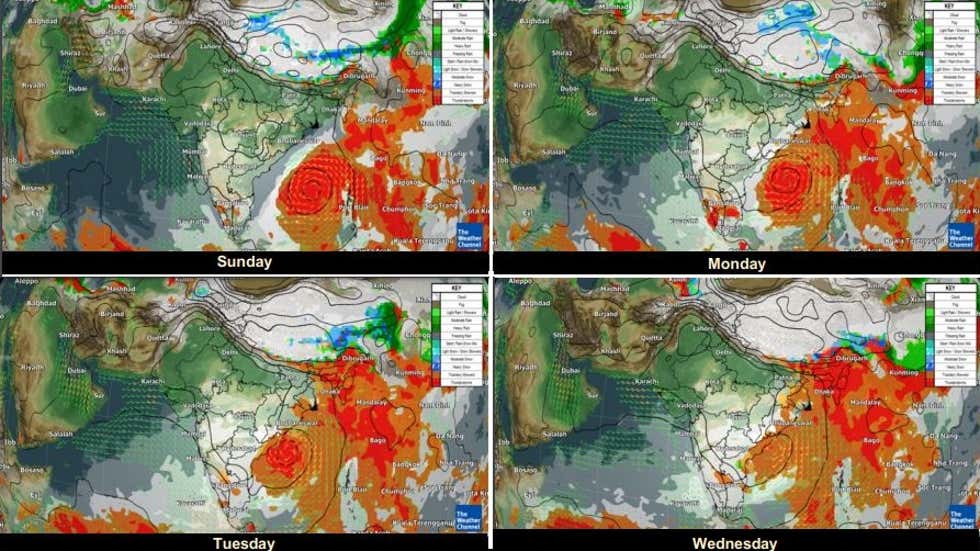
    Current Position of Cyclone Tauktae

    Quick Update on Cyclone Tauktae

    NORTH INDIAN OCEAN AREA (MALAY PENINSULA WEST TO COAST OF AFRICA):
    A. TROPICAL CYCLONE SUMMARY: NONE.
    B. TROPICAL DISTURBANCE SUMMARY:
    (1) THE AREA OF CONVECTION (INVEST 90B) PREVIOUSLY LOCATED
    NEAR 6.6N 92.4E IS NOW LOCATED NEAR 7.2N 93.5E, APPROXIMATELY 292 NM
    WEST-SOUTHWEST OF PHUKET, THAILAND. ANIMATED ENHANCED INFRARED
    SATELLITE IMAGERY DEPICTS A DISORGANIZED DISTURBANCE WITH WEAK
    FLARING CONVECTION THAT IS OFFSET TO THE WEST OF AN AREA OF BROAD,
    ELONGATED, AND ILL-DEFINED LOW LEVEL CIRCULATION. A 301431Z AMSU-B
    89GHZ MICROWAVE IMAGE REVEALS A LACK OF CONSOLIDATION AND FORMATIVE
    CONVECTIVE STRUCTURE. HOWEVER, INVEST 90B IS IN A FAVORABLE
    ENVIRONMENT FOR DEVELOPMENT WITH WARM (29-30C) SEA SURFACE
    TEMPERATURES, ABUNDANT WESTWARD OUTFLOW, AND MODERATE (10-20 KNOT)
    VERTICAL WIND SHEAR ALOFT. GLOBAL MODELS ARE SPLIT IN AGREEMENT THAT
    INVEST 90B WILL MARGINALLY CONSOLIDATE AND INTENSIFY WITHOUT
    REACHING TC STRENGTH WITH THE MODEL CONSENSUS TRACKING THE VORTEX
    GENERALLY NORTH-NORTHEASTWARD TOWARD YANGON, MYANMAR. MAXIMUM
    SUSTAINED SURFACE WINDS ARE ESTIMATED AT 10 TO 15 KNOTS. MINIMUM SEA
    LEVEL PRESSURE IS ESTIMATED TO BE NEAR 1004 MB. THE POTENTIAL FOR
    THE DEVELOPMENT OF A SIGNIFICANT TROPICAL CYCLONE WITHIN THE NEXT 24
    HOURS REMAINS LOW.
    (2) NO OTHER SUSPECT AREAS.
    C. SUBTROPICAL SYSTEM SUMMARY: NONE.
    Where is Khajuraho in Madhya Pradesh India

    Khajuraho is one of the city from the various major cities of Madhya Pradesh, Khajuraho is located Chhatrpur District of Madhya Pradesh, an state of India, the Lat. Long. of Khajurahois 24°51′00″N 79°55′30″E , and the height of this Town from sea level is 283 m (928 ft), the nearest Airport is Khajuraho Airport i.e 3 km south of Khajuraho Town and it has direct flights to Delhi and Varanasi. Khajuraho railway station connects the town by a daily train to Delhi via Mahoba, Jhansi and Gwalior.

    Where is Khajuraho located in India

    Location Map of Khajuraho showing on Google map of India

    Information about Khajuraho

    Name Khajuraho
    District Chhatarpur
    State Madhya Pradesh
    Country India
    Continent Asia
    Area NA
    Population 2,48,11,24,481
    Population Density NA
    Lat Long 24°51′00″N 79°55′30″E
    Time Zone IST (UTC+5:30)
    STD 7686
    Zip Code Start 471606
    Languages Hindi
    Rivers Ken
    Airports Khajuraho Airport
    Vehicle registration NA
    Sex ratio 1100
    Literacy 76.91%

    What to see in Khajuraho

    Sequence Modern temple name Religion Deity Completed by (CE)
    1 Chausath Yogini Hinduism Devi, 64 Yoginis 885
    2 Lalgun Mahadev Hinduism Shiva 900
    3 Brahma Temple Hinduism Shiva 925
    4 Lakshmana Hinduism Vaikuntha Vishnu 939
    5 Varaha Hinduism Varaha 950
    6 Parshvanatha Jainism Parshvanatha 954
    7 Ghantai Jainism Adinatha 960
    8 Mahishasuramardini Hinduism Parvati 995
    9 Vishvanatha Hinduism Shiva 999
    10 Matangeshwar Hinduism Shiva 1000
    11 Vishnu-Garuda Hinduism Vishnu 1000
    12 Beejamandal Temple ruins Hinduism Shiva 1000
    13 Ganesha Hinduism Shiva 1000
    14 Jagadambi Hinduism Devi Jagadambi 1023
    15 Chitragupta Hinduism Shiva 1023
    16 Adinath Temple Jainism Adinatha 1027
    17 Shantinatha temple Jainism Shantinatha 1027
    18 Kandariya Mahadeva (the largest temple) Hinduism Shiva 1029
    19 Vamana Hinduism Vamana 1062
    20 Javeri Hinduism Shiva 1090
    21 Chaturbhuja Hinduism Vishnu 1110
    22 Duladeo (Duladeva) Hinduism Shiva 1125